
Raquel Fiaes
"BEATTY: I can’t eat any apples! I feel like I’m always pretending, and I don’t know why! All I want is to remember what one tastes like but it’s like there’s something keeping me away from it!" (Page 18)
Research Question
How can the understanding of Mary’s hysteria being influenced by the LAUGH sign inform the performance choices of her actors?
Main Concept
In my research, some emphasis will be placed on the LAUGH sign, although it will mostly serve as a supplemental aspect of the main concept, which is female hysteria. In Utopia, hysteria is never directly referenced. However, Charlotte and Johnny accuse Beatty and Mary of being “delirious” multiple times, even when they are being perfectly rational in questioning the rules of the simulation (Barroso, 2025). This gaslighting from Charlotte and Johnny pushes Mary into actual hysteric behaviour. As I will illuminate with my research, instigation of hysteria is a common theme in the classical study of the illness.
Central findings
The first discovery I have made in my research is the way Charlotte encourages Mary’s hysteria for the audience, and the historiography that correlates to this. Invention of Hysteria follows the studies of Jean-Martin Charcot in his pursuit to medically define hysteria through photographs of real female inpatients, for which they were medically manipulated into hysteric attacks (Didi-Huberman, 1982). One patient in particular, Augustine, was a favourite subject of

Charcot, “her whole destiny… is a punishment through images. An act she is forced to perform, all the movements of all her limbs executed beyond her will” (1982, p. 162).
Charlotte’s manipulation of Mary is very similar, though it is psychological and emotional in nature rather than physical. After Mary performs her hysteria, which is stabbing Johnny, Charlotte says, “I knew you had it in you, dear” (Barroso, 2025, p. 26). This proves her plot all along to, like Charcot, use manipulation techniques to incite a performance.
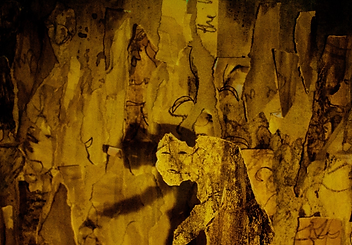
My subsequent focus is physical manifestations of hysteria. A prime example of this is the wallpaper in The Yellow Wallpaper by Charlotte Perkins Gilman. The main character in the story is suffering from what seems like the modern understanding of post-partum mental illness, mistaken for female hysteria. Her condition is advanced by the unsettling wallpaper in her room; “the narrator continues to fixate upon the wallpaper as the source and embodied material reality of her physical and social condition” (Delchamps, 2020, pp. 115-116).
She laments, “I peeled off all the paper I could reach standing on the floor. It sticks horribly and
the pattern just enjoys it! All those strangled heads and bulbous eyes and waddling fungus growths just shriek with derision” (Perkins Gilman, 1892, p. 9). While this woman is being tormented by the state of the wallpaper, Mary is being plagued by the laughs of the audience as a result of the sign. In terms of the ontology of the sign, it has being both in the world of the playand to the audience. As verbally confirmed to me by playwright Joshua Barroso, Charlotte can always hear the audience’s reactions, Mary can but tries to ignore it, and Beatty and Johnny do ignore it. In this way, Mary is pushed by Charlotte using the LAUGH sign and eventually gives into her own hysteria, just like the woman becoming increasingly hysteric on account of the wallpaper in The Yellow Wallpaper.
With understandings of hysteria as a forced performance and as something that can be physically manifested, I will suggest implementations of hysteric movement in Utopia that are influenced by those factors. Before applying concrete examples of hysteria, it must be known how it fits into the world of the play on account of its traditional role: “The hysteric arrives, partly, as the repressed, to show the cracks in the system, to point out the violent practices of patriarchy – practices that continue but that are not working” (Cole, 2021, p. 182). I believe that Utopia is written in a way that sheds light on this fact; Mary’s hysteria, though performed on behalf of Charlotte, is a product of her years of difficulties with Johnny. After all, she ends up killing him. To highlight this, perhaps Mary should begin to show slight hysteric movements in
the “Technical Difficulties” scene, when her and Johnny


are fighting in the real world (Barroso, 2025, p. 20). But what exactly is ‘hysteric movement’? Below is a diagram composed by Charcot and his associates that represents the different stages of a hysteric episode, and the specific actions that go along with each.

Seeing that most of these actions are performed laying down, it would be difficult to fully placethem in Utopia without a valid reason for Mary to be on the floor. However, I believe that these could be edited to movements of only her limbs. Similar to what is seen in the chart and the prior image of Augustine, abrupt motions of the arms and legs could inform the
performance of Mary’s hysteria before and after killing Johnny, with movements starting small and getting larger over time.
Moreover, above is an image from The Yellow Wallpaper, which depicts the narrator crawling over her unconscious husband in a fit of hysteria. This action could fit very easily into Utopia, after Mary kills Johnny.